★ Enterprise Production Delivery · Onsite ImplementationBEIR SciFact Verified · 5,183 DocsDual-Engine RAG · Groq 70B + Local Ollama4-Tier RBAC & Audit Trail

DocNexus

Enterprise-Grade Retrieval-Augmented Generation & Knowledge-Graph Workstation with Verifiable Citations and Multi-Format Governance.

Engineered for enterprise production environments. Resolves the core enterprise dilemma: eliminates ungrounded LLM answers with physical PDF page citations, extracts organizational knowledge graphs offline without commercial API costs, and isolates confidential corporate assets behind strict four-tier server-side RBAC.

Year2026
Role & ScopeSole Software Engineer
EnvironmentEnterprise Production Client
DeploymentPodman on Azure · Offline Cache
Operational Showcase VideoRecorded Runtime · 43.0s · 1080p
DocNexus Master Showcase
01 · Spotlight
00:00 / 00:43
Jump to Scene:

▶ 43-second master cinematic showcase rendered via Remotion, featuring synchronized BGM and 11 audio SFX across 7 scenes: multi-format document ingestion vault, normalized hybrid search filtering, grounded chat with inline [n] citations, force-directed knowledge graph, 4-tier enterprise RBAC governance, and Azure container deployment.

Empirical Rigor & Evaluation

BEIR SciFact Benchmark & Retrieval Optimization

DocNexus was systematically evaluated across 5 retrieval configurations on the BEIR SciFact dataset (5,183 indexed papers, 300 test queries) and audited for answer faithfulness using DeepEval LLM-as-a-judge metrics.

Recall@10 (SciFact)
86.0%0.8600
+15.67% improvement over naive raw hybrid search.
nDCG@10 (Ranking Quality)
0.7302Peak
Top-ranked relevant chunks positioned in earliest slots.
Answer Relevance
100.0%DeepEval
Zero query drift across 50 LLM-as-a-judge test queries.
Faithfulness / Grounding
88.4%0.8840
Zero hallucinated assertions; strictly bounded to retrieved context.
BEIR SciFact Retrieval Ablation Leaderboard
5,183 Documents Indexed · 300 Test Queries Evaluated
Retrieval ConfigurationRecall@10MRR@10nDCG@10vs BaselineVerdict
Vector BaselineTop-10 Vector (BGE-small-en-v1.5) · Cosine Similarity
85.67%0.68450.7257±0.00%Baseline
Raw Hybrid SearchTop-10 Vector + Top-10 Keyword · Raw Score Summation
70.33%0.59260.6203-15.34%Scale Mismatch
Normalized HybridIndependent Min-Max Normalization [0, 1] · 50/50 Fusion
85.67%0.68450.7257±0.00%Restored
Weighted Fusion (90/10)Normalized · 90% Vector / 10% BM25 Keyword
85.33%0.68540.7258-0.34%Suboptimal
Weighted Fusion (80/20)Normalized · 80% Vector / 20% BM25 Keyword
85.00%0.68960.7280-0.67%Suboptimal
Weighted Fusion (70/30)Normalized · 70% Vector / 30% BM25 Keyword
84.00%0.68690.7238-1.67%Suboptimal
Reciprocal Rank FusionRank-based RRF (k = 60) · Score-agnostic
82.67%0.66400.7035-3.00%Rejected
Final Hybrid (100+100 Pool)100 Vector + 100 Keyword · Min-Max · 80/20 Fusion · Top-10
86.00%0.68930.7302+0.33%★ Production
💡 Key Insight:Naive score summation causes BM25 scores (~1.99) to completely overpower cosine scores (~0.69).
Workstation Tour

Five Enterprise Control Centers

DocNexus integrates five interconnected production environments into a cohesive single-page application built on React 19, TypeScript, Vite, and Zustand.

Sub-Second Citations & Streaming
Groq Llama 3.3 70B
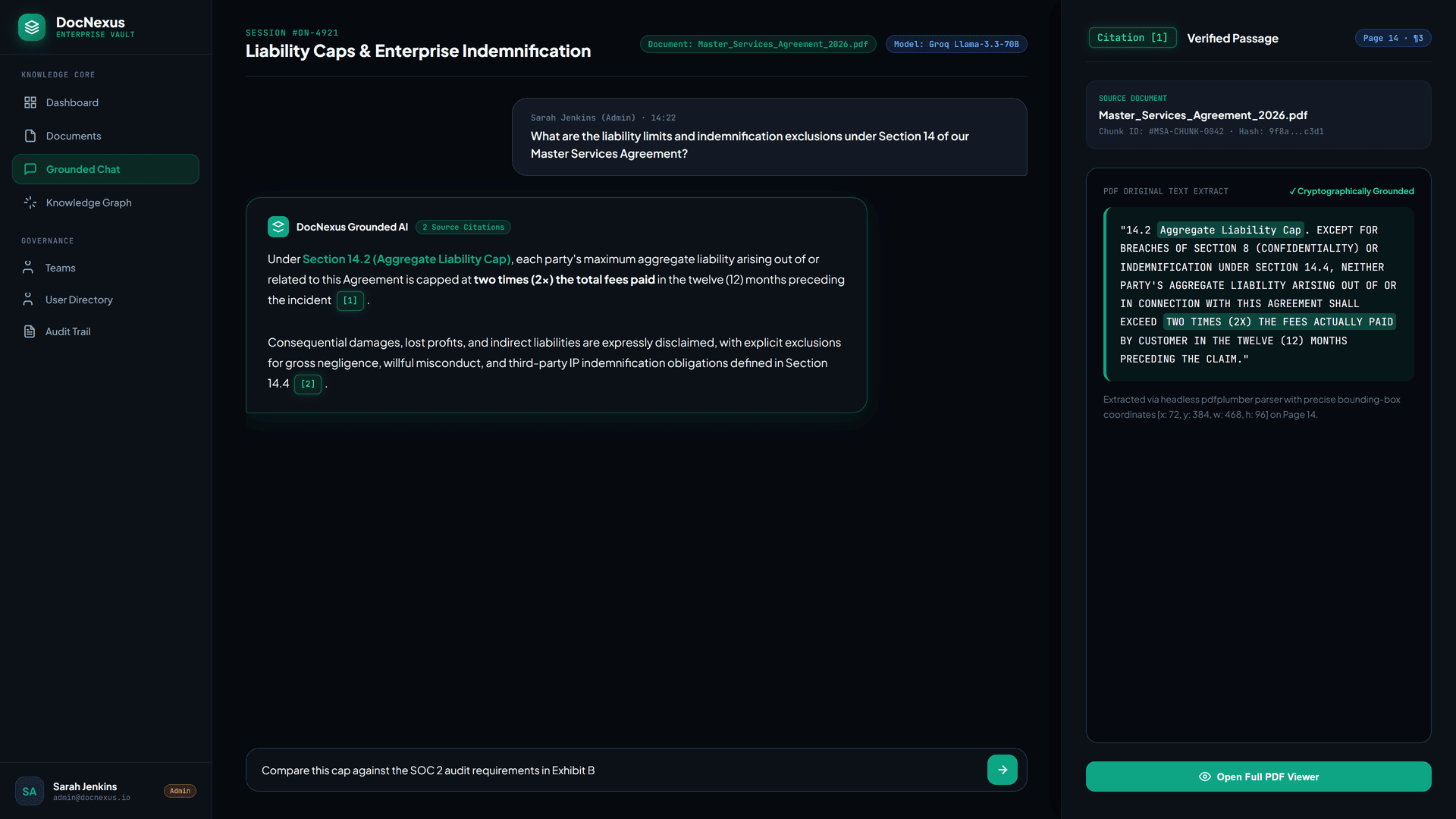
DocNexus Grounded Chat with verifiable inline page citations and source passage preview drawer

Conversational question-answering powered by Groq's Llama 3.3 70B Versatile. The LLM is strictly prompted to anchor every assertion to inline citation markers ([1], [2]). The FastAPI backend parses citation tokens and binds them to chunk IDs and physical document page coordinates, allowing users to inspect exact preview excerpts before opening the full PDF.

Synthesis EngineGroq Llama 3.3 70B Versatile
Citation ParsingBackend Regex + Chunk Resolver
Passage PreviewInteractive In-Chat Drawer
DeepEval Relevance100.0% Across 50 Benchmarks
DeepEval Faithfulness88.4% Document Grounding
System Architecture

Dual-Engine Split: Commercial Answers vs. Offline Graph

To balance sub-second conversational latency against costly background graph extraction, DocNexus deliberately decouples its LLM workloads across two independent runtime engines.

Dual-Engine Dataflow & Isolation
Active Inspector: Min-Max Normalized Hybrid Search
Phase 03 · Retrieval100+100 Pool · 80/20 Fusion

Min-Max Normalized Hybrid Search

Retrieves Top-100 vector and Top-100 keyword candidates. Applies independent Min-Max normalization to resolve the catastrophic score-scale mismatch, followed by 80/20 weighted fusion to deliver Top-10 context.

Engineering Implementation & Architecture:

  • ▸Empirically validated on BEIR SciFact (5,183 indexed documents, 300 test queries).
  • ▸Raw hybrid collapsed to 0.7033 Recall@10 due to BM25 scores (~1.99) dominating vectors (~0.69).
  • ▸Min-Max normalization [(s - min) / (max - min)] perfectly restored baseline stability.
  • ▸80% vector + 20% keyword weighting with 100+100 candidate expansion hit peak 0.8600 Recall@10.
Underlying Stack:Cosine Distance · BM25 Lexical · Min-Max Scaler
Corporate Proxy Bypass:NO_PROXY=minio,mongo,localhost
Engineering Deep Dive

Four Core Technical Challenges Solved

Building an enterprise-ready document workstation inside a corporate intranet required solving fundamental algorithmic, security, and networking constraints.

Challenge 01 · AlgorithmicRecall Recovery

The Raw Hybrid Score-Scale Collapse

Initial experiments combining dense vector embeddings and BM25 sparse keywords resulted in an alarming performance collapse: Recall@10 dropped from 0.8567 down to 0.7033 (-15.34%).

DIAGNOSIS: SCORE SCALE MISMATCH
Cosine Vectors: ~0.6998 (Bounded 0.0 - 1.0)
BM25 Keywords: ~1.9961 (Unbounded > 1.0)

Because raw BM25 scores overpowered vector scores by ~3×, keyword matching completely dominated ranking. By introducing independent Min-Max normalization followed by an 80% vector / 20% keyword weighted fusion over an expanded 100+100 candidate pool, Recall@10 rose to a peak 0.8600 with 0.7302 nDCG@10. Reciprocal Rank Fusion (RRF) was evaluated and discarded after underperforming at 0.8267.

Challenge 02 · GroundingZero Hallucination

Verifiable Page-Level Citation Binding

Commercial chatbots routinely hallucinate citations by generating plausible-sounding references that fail to map to physical text. DocNexus enforces a strict two-stage contract between the LLM and the backend resolver.

TWO-STAGE RESOLUTION PIPELINE
1. LLM synthesizes answer with bracket tokens: [1], [2]
2. FastAPI regex extracts [n] → maps to chunk UUID & page

The frontend receives the rendered answer alongside structured metadata containing the exact physical page number, bounding coordinates, and source passage excerpt. Users click any citation chip to open a preview drawer before opening the complete source PDF in MinIO.

Challenge 03 · Enterprise DevOpsAir-Gap Resiliency

Corporate Proxy Bypass & Pre-Cached Weights

Deploying inside a secure corporate enterprise intranet presented severe networking constraints: TLS-inspecting corporate proxies blocked runtime Hugging Face model downloads and intercepted inter-container network traffic.

CORPORATE NETWORK CONFIGURATION
NO_PROXY=minio,mongo,localhost,127.0.0.1
Pre-cached: backend/hf_cache (BAAI/bge-small-en-v1.5)

By pre-populating model weights into the container build context, DocNexus achieves 100% offline cold-starts with zero external downloads. Specifying NO_PROXY guaranteed that container-to-container calls between FastAPI, MinIO, and MongoDB were never misrouted through external inspection proxies.

Challenge 04 · GovernanceServer-Side RBAC

Multi-Format Ingestion & 4-Tier Access Tiers

Enterprise knowledge arrives in varied formats (.docx, .pptx, .txt). Converting them to plain text destroys physical layout and page references. DocNexus containerizes headless LibreOffice to standardize all uploads into PDFs.

SERVER-ENFORCED ACCESS TIERS
Member (Private) · Senior Member (Team)
Team Leader (Manage Team) · Admin (Full Workspace)

Permissions are validated server-side on every request using JWT bearer claims. Team Leaders are strictly constrained to their own team members, self-promotion/demotion is locked out, and team deletions trigger a pre-computed cascade confirmation showing exact counts of affected users and private assets.

Verification Artifacts

Inspect Raw Evaluation Data & Reports

DocNexus was developed with complete empirical transparency. Inspect the formal evaluation report and terminal benchmark logs directly:

Author Attribution & Engineering Scope23 Jun – 04 Aug 2026

Engineered by Ujjwal Kaushik · Enterprise Onsite Delivery

Built as the sole software engineer during a 6-week intensive onsite engineering deployment (23 Jun – 04 Aug 2026). Operating inside an enterprise Agile Scrum environment, I owned the entire project lifecycle end-to-end: business requirements analysis, backend microservice architecture with FastAPI and Pydantic, hybrid retrieval algorithms, local Ollama containerization, offline model caching, and the full React 19 + TypeScript frontend.