SANKET
v1.0 ReleaseAI-Assisted Virtual Camera Tracking System for Coarse Optical Alignment of Mobile Free Space Optical Communication (FSOC) Terminals.
An air-gapped Software-in-the-Loop (SIL) simulation and tracking workstation developed for the Department of Space and the Indian Space Research Organisation (ISRO) under Smart India Hackathon 2026.
▶ High-definition operational walkthrough showcasing real-time optical beacon acquisition, 3D pedestal frustum visualization in Three.js, 2000×2000 wide-area spatial monitoring, and the automated 19-scenario ISRO benchmark matrix under noise and fog.
Measured Runtime Scorecard (Run ID: run_1790716901)
Recorded automatically by SANKET's telemetry engine during an uninterrupted clean execution of scenario_2_circular across 900 frames under zero-fabrication logging.
Five Integrated Production Workspaces
Explore the five specialized operator consoles engineered natively within PySide6 and QtWebEngine.
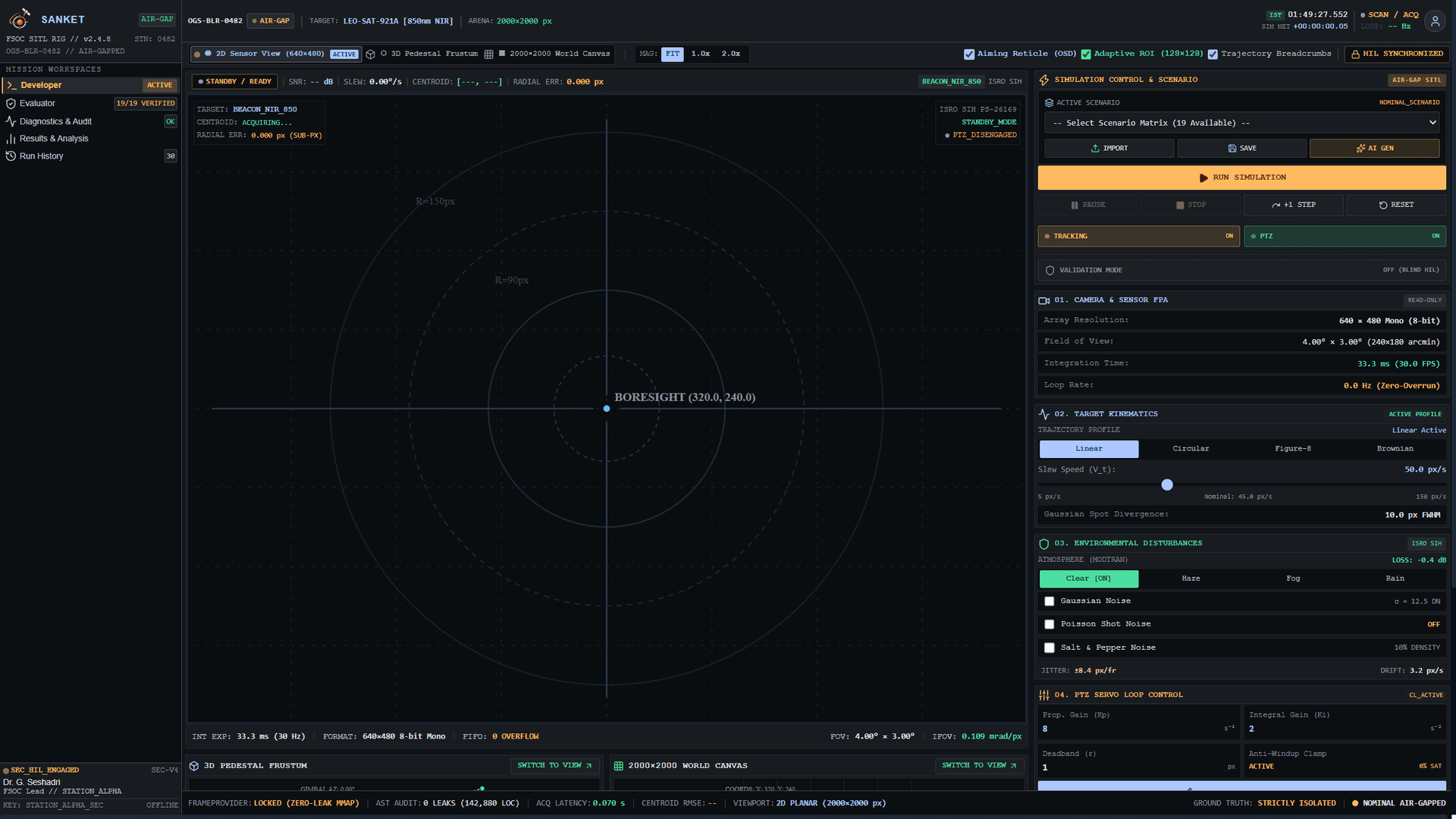
The primary coarse alignment detector viewport. Displays the degraded 8-bit monochrome frame with live HUD overlays: cyan boresight crosshairs, a 1.5 px deadband radius circle, green candidate bounding boxes, and the sub-pixel intensity centroid reticle. Operating solely on raw pixel data, it tracks the Gaussian PSF beacon spot across adverse noise.
The Spatial Uncertainty Cone in Deep-Space Laser Links
Unlike broad radio frequency (RF) broadcasts, Free Space Optical Communication relies on laser beams with microradian-level divergence angles (50 μrad to 2 mrad) over hundreds to thousands of kilometers. When mobile terminals (LEO satellites, UAVs, and optical ground stations) initiate a link, relative positioning from GPS and IMU ephemeris contains positional errors that form an uncertainty volume.
Fine-steering mirrors (FSMs) or quadrant photodiodes cannot establish lock within such an uncertainty envelope. A coarse Pointing, Acquisition, and Tracking (PAT) system must first sweep the spatial cone, detect the beacon spot on a wide Focal Plane Array, and center the beam onto the optical axis before handoff.
Why an Air-Gapped Software-in-the-Loop Lab Was Essential
Validating and benchmarking coarse alignment algorithms on physical optomechanical gimbals is cost-prohibitive, fragile, and difficult to reproduce under controlled atmospheric disturbances.
SANKET solves this barrier by delivering a self-contained, air-gapped simulation workstation running on commercial hardware. It models optical lens projection (f = 9167.3 px), Gaussian diffraction PSFs, Beer-Lambert atmospheric transmittance across 5 regimes, sensor noise (Salt & Pepper, Gaussian, Poisson), and closed-loop pan/tilt mechanics without requiring any cloud connection or elevated privileges.
The Optical Alignment Rig — High-Level Pipeline
Follow the journey of an optical beacon from deep-space transmission to closed-loop gimbal lock. Switch between Story Mode for intuitive physical metaphors and Engineer Mode for aerospace specifications.
A physical mechanical metaphor of SANKET's complete air-gapped simulation & tracking pipeline.
Deep-Space Satellite Beacon Emitter
“The Long-Distance Flashlight”
A laser transmitter mounted on a distant satellite or drone shining an optical beacon beam across thousands of kilometers of empty space toward Earth.
src/simulation/target_manager.py · TargetManager
Simulates deep-space beacon kinematics across 4 trajectory models (Static, Linear, Circular, Lissajous) on a 2000×2000 px virtual canvas with sub-pixel ground-truth tracking.
Perception Blind to Ground Truth by Architectural Law
In academic and hackathon computer vision projects, tracking algorithms often “cheat” by importing or reading simulation target coordinates directly. SANKET enforces an inviolable Architectural Ground-Truth Firewall:
- ▸The perception pipeline receives strictly raw pixel matrices (
uint82D NumPy array) viaSimulationFrameProviderorMP4FrameProvider. - ▸Ground truth coordinates exist solely inside
GroundTruthProviderand are routed exclusively to the post-hocMetricsEnginefor error calculation. - ▸Verified automatically by static Abstract Syntax Tree (AST) inspection tests (
test_ground_truth_firewall_inspection) ensuring zero module imports or coordinate leaks.
# 1. Tracker receives raw sensor pixels only:
frame_packet = frame_provider.get_frame()
raw_image: np.ndarray = frame_packet.image  # (480, 640) uint8

# 2. Perception algorithms run completely blind:
candidates = detection_engine.detect(raw_image)
filtered   = ai_classifier.filter(raw_image, candidates)
centroid   = centroid_estimator.estimate(raw_image, filtered[0])

# 3. PTZ gimbal controller operates strictly on sensor error:
error_x = centroid.x - 320.0  # Boresight X offset
error_y = centroid.y - 240.0  # Boresight Y offset
ptz_cmd = ptz_controller.update(error_x, error_y)

# 4. GroundTruthProvider feeds ONLY MetricsEngine:
ground_truth = gt_provider.capture(frame_number)
metrics_engine.record(estimated=centroid, true=ground_truth)
Algorithmic Perception & Closed-Loop Gimbal Kinematics
Four tightly coupled mathematical stages engineered for sub-millisecond execution and deterministic stability.
Adaptive Contrast Thresholding & Morphological Opening
Evaluates an adaptive local contrast threshold T = μ_local + k · σ_local across candidate regions. Applies a 3×3 morphological opening kernel to strip single-pixel impulse Salt & Pepper noise, extracting connected component bounding boxes that meet minimum beacon area constraints.
Calibrated 4-Feature AI Clutter Rejection Classifier
Replaces slow deep learning models with an ultra-lightweight calibrated Logistic Regression classifier trained on spot circularity, intensity ratio, fill factor, and spatial contrast gradient. Rejects sensor artifacts in microseconds with automatic fallback to RuleBasedClassifierFallback.
Sub-Pixel Intensity-Weighted Center of Gravity (CoG)
Sub-pixel localization estimates the local background intensity strictly from the perimeter border pixels of the bounding box, preventing the bright central optical beacon from corrupting the background baseline. Computes sub-pixel coordinates achieving 100.0% of frames with < 1.0 px error.
Closed-Loop PID Gimbal Control & Expanding Search
A dual-axis PID velocity controller actuates pan/tilt angular rates with dynamic clamping to ISRO's 10.0°/s limit. Features conditional anti-windup clamping to prevent actuator overshoot and an Expanding Square Search (ESS) generator with 25% overlap when acquiring targets in the SEARCH state.
ISRO Problem Statement 26169 Compliance Audit
Formal verification mapping every mandated parameter of the Department of Space specification against SANKET's measured runtime results.
| Parameter Category | Mandated Threshold (PS-26169) | SANKET Measured Value | Status |
|---|---|---|---|
| Virtual Canvas Dimensions | ≥ 2000 × 2000 pixels | 2000 × 2000 px Orthographic Ground Plane | PASS |
| Camera Sensor Resolution | 640 × 480 px Monochrome FPA | 640 × 480 px Single-Channel uint8 FPA | PASS |
| Camera Field of View | 4.0° × 3.0° FOV | 4.0° (H) × 3.0° (V) Lens Model (f = 9167.3 px) | PASS |
| Gimbal Pan/Tilt Max Speed | 5.0°/s to 10.0°/s Limit | Dynamic rate clamping strictly at ≤ 10.0°/s | PASS |
| Target Acquisition Time | ≤ 2.000 s | 0.067 s (Frame 2 at 30 FPS · +96.5% Margin) | PASS |
| Steady-State Tracking Error | ≤ 10.00 pixels | 4.823 px Mean Radial Error (+51.8% Margin) | PASS |
| Target Loss Rate | < 5.00% | 0.000% (0 / 898 frames lost · 100% Lock) | PASS |
| Algorithmic Processing Speed | ≥ 20.0 FPS | 461.82 FPS (0.88 ms P50 Latency · +313% Margin) | PASS |
| Disturbance & Noise Models | S&P, Gaussian, Poisson, Jitter | Gaussian (σ≤20), 10% S&P, Poisson, ±20px Jitter, 5 Fog Modes | PASS |
| Benchmark 2 Decoupled Mode | Ingest external 30 FPS MP4 | OpenCV VideoCapture pipeline with PTZ bypass & CSV comparator | PASS |
| Ground-Truth Isolation | Air-tight firewall | Zero AST leaks; tracker receives raw pixel matrix only | PASS |
- Python 3.11
- OpenCV
- NumPy
- PySide6
- QtWebEngine
- React 19
- TypeScript
- Three.js
- Tailwind CSS
- Pytest
Individual Technical Ownership
Built for Smart India Hackathon 2026 (Team Run_Time_Terror, ISRO Problem Statement 26169). Sole developer across the entire core system: engineered the simulation engine, optical projection geometry, disturbance models, computer vision pipeline, PID control laws, benchmark harness, and the complete React 19 + Three.js + PySide6 desktop workstation application.
While submitted under team “Run_Time_Terror” for Smart India Hackathon 2026, I personally handled the entire development process end-to-end: architected the Software-in-the-Loop simulation engine, authored the mathematical optical model, engineered the sub-pixel computer vision pipeline and PID rate controller, developed the automated 19-scenario evaluator harness, built the React 19 / Three.js 3D frontend, integrated the QtWebChannel IPC bridge with PySide6, and compiled the standalone air-gapped executable package.
Formal Aerospace Documentation & Deliverables
Inspect the comprehensive engineering reports, user manuals, and source artifacts submitted for SIH 2026 evaluation.
Technical Report
Full mathematical derivations: optical projection equations, PSF Gaussian modeling, PID control laws, ML classifier weights, and pytest methodology.
User & Evaluator Manual
Commercial operator reference guide with embedded figures, workspace workflows, parameter configuration dictionaries, and CLI headless instructions.
Performance Summary
Executive verification report of run_1790716901: timing distributions, latency percentiles, error standard deviation, and SIH scorecard sign-off.